


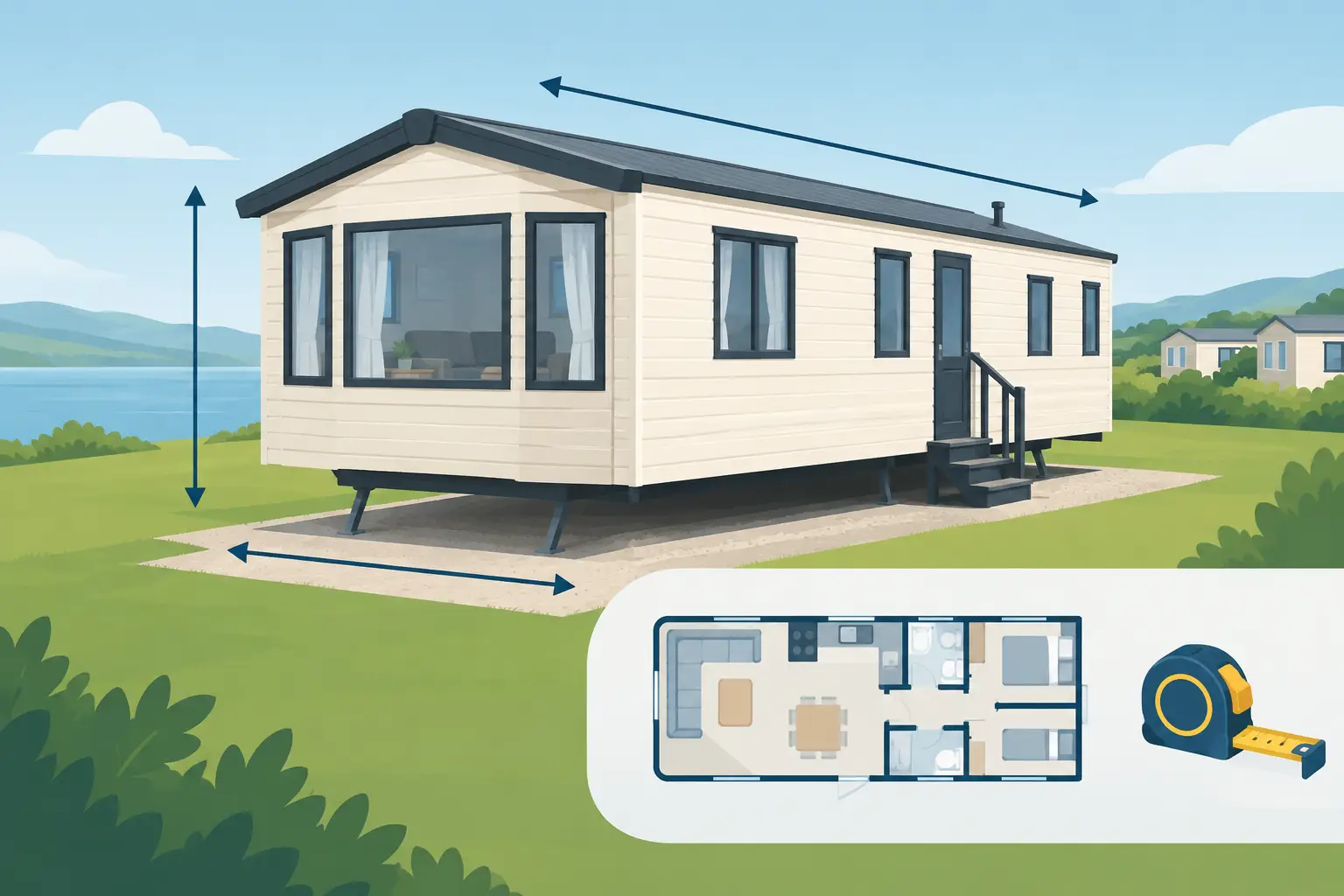
A static caravan that looks ideal on paper can still be wrong for the pitch, access road or intended use. This static caravan dimensions guide explains the measurements that matter before you commit to a caravan, holiday home or lodge for delivery anywhere in Great Britain.
A stated size such as 36 x 12 ft is a useful starting point, but it does not tell the whole story. Buyers also need to consider bedroom layout, wall thickness, roof height, chassis size, door position, transport access and the available clearance on site. For a holiday park, the park’s own pitch rules will usually be the deciding factor. For private land, site access and any permissions needed should be checked before purchase.
How static caravan dimensions are shown
Static caravans are normally described by their body length and width in feet. A 36 x 12 ft model is approximately 36 feet long by 12 feet wide, excluding any separate decking, steps and, in most cases, the drawbar. The quoted size should always be confirmed against the individual caravan specification, particularly on pre-owned stock where manufacturers’ layouts can vary by model year.
Length runs from the front to the rear of the main body. Width is measured across the caravan body and has the greatest effect on interior space. Two caravans of the same length can feel very different if one is 10 ft wide and the other is 12 ft or 14 ft wide.
Height is less often included in sale titles, but it is essential for delivery planning. Low bridges, tree branches, narrow gateways and overhead cables can all affect whether a unit can reach its final position. The transport team will need accurate access information before a delivery date is confirmed.
Common static caravan sizes in the UK
There is no single standard size, but most holiday caravans fall within a familiar range. Older and entry-level models tend to be narrower, while newer holiday homes and residential-specification lodges are generally wider and longer.
| Typical size | Common use | What to expect | |—|—|—| | 26-30 x 10 ft | Compact holiday caravan | Often one or two bedrooms, practical for smaller pitches and tighter budgets. | | 28-35 x 12 ft | Popular family holiday home | Usually two or three bedrooms, a usable lounge and a more generous kitchen-dining area. | | 36-40 x 12 ft | Larger holiday home | Better bedroom proportions, more storage and layouts suited to longer stays. | | 38-42 x 13 ft or 14 ft | Premium holiday home or lodge | Wider living areas, larger bathrooms and a more residential feel. | | 40 ft plus, often 20 ft wide | Twin-unit lodge | A large-format option delivered in sections and joined on site. |
A 10 ft wide caravan may be the sensible choice where access is restricted or the available pitch is narrow. It can also offer good value for a first purchase. The trade-off is that the central corridor, bedrooms and shower room will be more compact.
At 12 ft wide, there is usually enough room for a comfortable family layout without moving into lodge-level transport and siting requirements. This is why 12 ft wide caravans remain one of the most common choices for holiday parks and private plots. A 13 ft or 14 ft model gives a noticeable improvement in lounge width and bedroom space, but it needs a larger pitch and may not be accepted on every park.
Static caravan dimensions guide: choosing by layout
Do not choose on external measurements alone. Ask for the bedroom count, bathroom arrangement and floorplan, then consider how the caravan will actually be used.
For weekends and school holidays, a two-bedroom 32 x 12 ft caravan can work well for a couple or small family. In many layouts, one bedroom is a double and the other contains twin beds. A three-bedroom caravan of a similar overall size is possible, but the bedrooms will be smaller and storage will be limited. If children will be staying regularly, extra length can be more useful than simply adding another bedroom.
A 36 x 12 ft or 38 x 12 ft model often gives better separation between the lounge and sleeping areas. It may also provide an en-suite WC, a larger shower room or a fitted dining area. Those details matter for longer holidays and for buyers who want accommodation that feels less temporary.
For private land, guest accommodation or extended family use, look carefully at the lounge seating, dining capacity and kitchen worktop space as well as sleeping numbers. A caravan advertised as sleeping six can do so, but it may not seat six comfortably for meals on a wet afternoon. Wider models are particularly beneficial here because they allow furniture to be positioned without narrowing walkways.
Residential-specification caravans and lodges are another step up. Their dimensions are often paired with improved insulation, fully central heating and double glazing. They are designed for more regular use, but suitability for year-round occupation depends on the site licence, local planning position and the individual product specification. The construction standard does not automatically grant permission to live on land permanently.
Check the pitch before buying
A caravan needs more space than its stated body dimensions. There must be room for the unit itself, safe access around it, steps, and any required separation from neighbouring caravans or structures. Holiday parks set their own rules on acceptable length, width, age and siting clearances, so obtain written confirmation before arranging delivery.
Measure the usable pitch, not just the area shown on a plan. Allow for fencing, hedges, utility boxes, gas bottles, drainage points and the direction of any opening doors. If you plan to add decking, establish whether the park permits it and how much ground it will occupy. A caravan that technically fits may still leave no practical space for access or outdoor seating.
On private land, assess the final position as well as the route to it. Sloping ground may require preparation, levelling or suitable supports. The chassis must sit correctly, and services such as electricity, water and drainage need to be planned by competent installers. Before buying, take advice on planning requirements and intended use from the relevant local authority.
Delivery access can limit your choice
The largest caravan that fits the pitch is not always the largest caravan that can be delivered there. A 14 ft wide holiday home may be suitable on site but impractical if the route includes a narrow lane, sharp turn, weak bridge or low tree canopy.
Provide clear photographs and measurements of entrances, gateways, lanes and the final turning area. Include the width between fixed objects, not just an estimate of the road width. Tell the transport provider about low cables, parked vehicles, tight corners and gradients. Where access is difficult, a site visit or more detailed assessment may be needed before transport is booked.
Remember that the caravan will arrive on specialist transport, with room needed to manoeuvre and unload it. A gateway that is only marginally wider than the caravan body may not allow enough clearance for a safe approach. Removing a gate, trimming overhanging branches or arranging temporary vehicle restrictions can sometimes solve an issue, but these arrangements should be agreed well in advance.
Measurements to confirm on every caravan
Before placing an order, confirm the stated length and width, the number and size of bedrooms, overall height for access planning, and the location of external doors. Check whether the dimensions include any bay window or feature projection. Ask where the utility connections sit and whether the caravan is supplied with steps, as these affect the final siting plan.
For a used caravan, condition matters alongside size. A competitively priced 35 x 12 ft unit may offer excellent family space, but inspect the flooring, roof, windows, heating, chassis and furnishings so that the full cost of ownership is clear. For a new caravan, compare the standard specification carefully. Central heating, double glazing, upgraded insulation and integrated appliances can make one similarly sized model better suited to your requirements.
Premier Caravans Ltd can help buyers match the available pitch and access route to suitable off-site stock, then arrange practical delivery support once the right unit has been chosen.
The best purchase is not simply the biggest caravan within budget. It is the model that fits the site properly, reaches it without difficulty and gives the right amount of usable space for the people who will enjoy it.